
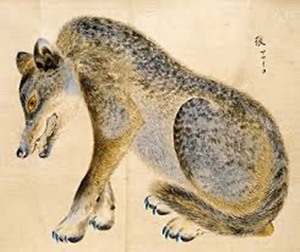
The Forgotten Wolf
Minami-Izu
032
In the forests of Minami-Izu lives Professor Maruyama, a long-time wolf
researcher, founder of the Japan Wolf Association, and Professor
Emeritus at Tokyo University of Agriculture and Technology.
As a young deer researcher in 1968, he began studying wildlife and
mountain ecosystems. At the time, there were only a handful of deer
researchers in Japan. After encountering wild wolves in Poland in 1988,
Professor Maruyama devoted himself to research on the restoration of
wolves to Japan.
From the perspective of wildlife conservation, he saw wolves as an
essential predator that could help restore balance to ecosystems
increasingly affected by the growing populations of deer and wild boar.
Today, Professor Maruyama advocates for the restoration of wolves in
Japan as a way to help address ecological imbalance caused by the
growing populations of deer and wild boar.
“What would happen if wolves returned to the forests of Izu?”
That question brought me to his home in Minami-Izu.
Are Wolves Really Dangerous?
When people hear the word “wolf,” many imagine the villain from Little Red Riding Hood or a dangerous predator that attacks livestock and humans. But according to Professor Maruyama, wolves are not naturally aggressive toward people. Historically, wolves tended to avoid humans and lived quietly within the forest.In traditional folklore and fables, wolves were not always portrayed as monsters. They often appeared as humorous, lovable, and sometimes even foolish characters. Some stories describe wolves falling in love,
making mistakes, and displaying qualities that feel surprisingly familiar to us. The image of the wolf as a terrifying villain may be more recent than many of us realize.
Wolves and the Japanese People
Shinto is Japan’s traditional belief system.Alongside ancestral spirits, mountains, seas, forests, and living creatures
have long been revered as sacred presences. For generations, forestcovered mountains were a source of life, providing water, timber, food, and countless gifts from nature.
They were seen as places where spiritual power resided. Because wolves preyed on deer and wild boar that damaged crops, they were also seen as protectors of the mountains and farmlands.
For this reason, wolves were once respected in Japan and regarded as messengers of the gods. At shrines such as Mitsumine Shrine and Mitake Shrine, wolves are revered as divine messengers, taking the place of the guardian lion-dogs commonly found at many Japanese shrines.
However, the perception of wolves began to change during the early Edo period with Shogun Tokugawa Tsunayoshi’s Edict of Compassion for Living Things (1687–1709), which marked the beginning of a shift toward viewing wolves as harmful animals.
By the Meiji era (1868–1912), Japan’s relationship with wolves had changed dramatically.
Why Did Wolves Disappear?
The disappearance of wolves did not happen overnight.Across Europe, wolves were hunted to protect sheep and goats. In Japan,
wolves were increasingly viewed as threats to horses, livestock, and human economic activities.
During the Meiji era, wolves were being eradicated across Europe, and as Japan sought to become a modernized "civilized nation," it followed a similar path.
The Japanese wolf is believed to have become extinct around 1905, near the end of the Meiji period.
Professor Maruyama reflected on an intriguing idea: perhaps some wolves adapted to life alongside humans and eventually became dogs, while those that remained in the mountains were gradually driven to extinction.
After all, dogs themselves are descendants of wolves.
What Happens When a Top Predator Disappears?
The disappearance of wolves altered more than the fate of a single species. Professor Maruyama points to the dramatic decline in Japan’s hunting population as another factor. In the 1970s, there were approximately 530,000 hunters in Japan. Today, that number has fallen to less than a quarter of its former size. As a result, populations of deer,wild boar, monkeys, and other wildlife have increased significantly,
contributing to ecological damage and agricultural losses.
At the same time, modern lifestyles have distanced people from the mountains in ways that previous generations never experienced. Lessons from Yellowstone
One of the most famous examples of wolf restoration comes from Yellowstone National Park in the United States. In 1995, wolves were reintroduced from Canada. Over time, elk populations declined,
vegetation recovered, and even riverbank ecosystems began to change.
The presence of wolves helped restore balance throughout the landscape.
For Professor Maruyama, the lesson is clear: top predators play an essential role in maintaining healthy ecosystems.
Looking Forward
The restoration of wolves in Japan remains a controversial and complex issue. There are many practical challenges involving agriculture, local communities, and wildlife management.Yet public interest appears to be growing. Surveys conducted in both urban and rural areas suggest that more people are becoming curious about the possibility of wolf restoration.
Today, many people know wolves only through fairy tales and folklore.
Yet we may have forgotten the predator that once played a vital role in maintaining the balance of forest ecosystems.