The Chohachi Art Museum
Matsuzaki
007
Have you ever visited the Izu Chohachi Art Museum in Matsuzaki, NishiIzu?The museum houses around 50 rare plaster relief works known as
kote-e, created by Irie Chohachi, a master plasterer who was active from
the late Edo period into the Meiji era.
The works themselves are remarkable. Yet the building is another reason
to visit. Here, the plaster culture that has continued since the Edo period
meets modern architecture.
This is not merely a space for displaying art. It is, in itself, a monumental
work of plaster art, marked by the ideas and handwork of architect Osamu
Ishiyama and the plasterers who sought to carry traditional craftsmanship
into the present.
From Namako Walls to Plaster Art
Matsuzaki has long been known for its plasterwork. The town is home to many namako walls, the distinctive black-and-white checkerboardpatterned walls that became common during the Edo period. These walls developed out of a practical need: to protect buildings from the frequent fires of the time by strengthening their exterior surfaces.
Irie Chohachi (1815–1889) transformed this practical plastering technique into a new form of artistic expression. By incorporating the painting techniques of the Kano school, which was considered one of the highest traditions of Japanese painting at the time, he opened up an entirely new world of plaster art. He skillfully layered plaster to create depth and dimension, then colored his works with natural pigments used in traditional Japanese painting. In doing so, he elevated plasterwork to an art form comparable in spirit to fresco painting.
Architect Osamu Ishiyama and Mayor Yoda
This modern architectural project began when Osamu Ishiyama, an architect deeply interested in plaster craftsmanship, published a concept in a plastering industry magazine. The article imagined what he would design if he were to create a memorial museum for Chohachi.
The person who was strongly drawn to this idea was Keiichi Yoda, the mayor of Matsuzaki at the time. Sensing that Ishiyama’s concept contained something important for the future of the town, Mayor Yoda invited him to Matsuzaki, and the two continued their conversations. Eventually, they found common ground and launched a two-year architectural project based on Ishiyama’s concept.
The Spirit of the Alhambra
One of the most intriguing conditions proposed by Mayor Yoda is reflected in the museum’s entrance. He believed that the building should be deeply rooted in Matsuzaki, making use of the town’s namako walls, while also carrying an international and open-minded architectural spirit.
As a model, he referred to the Alhambra in Spain, a palace where different cultures and religions once intersected and coexisted. Mayor Yoda wanted to create a place where diverse ideas could live and breathe. In response, Ishiyama incorporated elements reminiscent of the Alhambra’s cave-like corridors and spatial composition into the design.
The Space of the Chohachi Art Museum
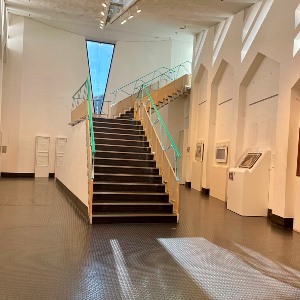
Step inside, and you will find a space quite different from an ordinary art museum. The ceilings and walls are formed with organic curves, while the thickness of the plaster and the traces of the trowel remain as expressions of the plasterers’ hands.
The traditional checkerboard pattern of the namako walls, the warm colors of Chohachi’s surviving works, and the modern design and visual effects of light come together within a single architectural space.
The Izu Chohachi Art Museum is not simply a box that holds works of art. It is an architectural space where plaster art, the history of Matsuzaki, and Osamu Ishiyama’s architectural vision overlap. The museum opened in July 1984, and the following year it received the 10th Isoya Yoshida Award as a building that “fuses Edo with the 21st century.”
This grand experimental architecture, created by Osamu Ishiyama together with plasterers from across Japan, is something to be experienced in Matsuzaki.